
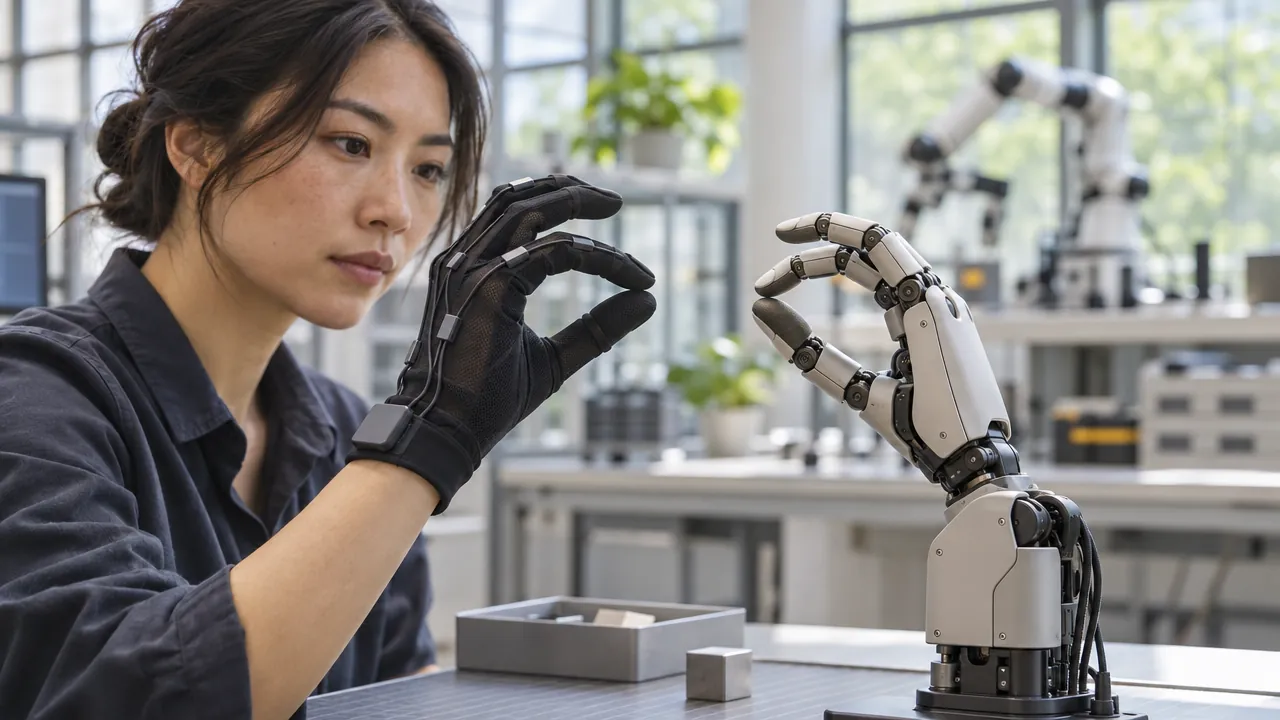
Genesis AI raised $500 million in a Series A round led by Khosla Ventures, Premji Invest, and Eclipse to develop dexterous robots trained with human hand-motion data. The company has built 30 to 40 robots and is piloting them with customers, but it still needs to prove reliable performance beyond the lab.
Key takeaways
- Genesis AI raised $500 million in a Series A led by Khosla Ventures, Premji Invest, and Eclipse.
- The company uses sensor-equipped gloves to capture human hand movements as potential robot training data.
- Genesis AI is developing its data, generative AI model, and robot hardware through a vertically integrated approach.
- The company has built 30 to 40 robots and begun pilots with a small number of customers.
- Genesis AI plans U.S. mass production in 2027, while dependable real-world performance remains a key hurdle.
Genesis AI has raised $500 million in a Series A round to develop robots designed for dexterous work. The company is betting that training robots with data captured from human hand movements can help them handle tasks that require more than basic picking and placing. It has built dozens of robots and begun piloting them with a small number of customers, but reliable performance outside the lab remains the key test.
Who Invested in Genesis AI's $500 Million Series A?
The round was led by Khosla Ventures, Premji Invest, and Eclipse. The financing follows a $105 million seed round that Genesis AI announced in July 2025.
Founded in 2024 by Xian and company president Théophile Gervet, Genesis AI is pursuing a vertically integrated approach. It aims to generate training data, develop its own generative AI model, and design and build its robots. That strategy gives the company direct control over several parts of the process, from the data used to teach a robot through to the machine performing the task.
The approach is ambitious: developing the software, gathering useful data, and producing hardware all require substantial investment. The new funding gives Genesis AI more resources to advance those efforts and move toward commercial deployment.
How Genesis AI Uses Gloves to Train More Dexterous Robots
Genesis AI is focusing on robot dexterity - the ability to manipulate objects and carry out precise hand movements. Its approach includes sensor-equipped gloves that capture how people move their hands while performing tasks. That information can then help train robots to reproduce those actions.
The company has highlighted tasks such as sorting and manipulating wires, which demand controlled, adaptable movements. Collecting human demonstrations through gloves is intended to provide examples of how hands handle objects, rather than relying only on a robot learning through trial and error.
This emphasis on dexterity and data collection distinguishes Genesis AI's stated focus from competitors such as Figure and Agility, which are also developing humanoid robots. The comparison is less about a single measure of performance than about what each company is prioritizing: Genesis AI is placing particular weight on collecting human-motion data and teaching fine-grained manipulation.
What Genesis AI Has Built - and What Comes Next
Genesis AI has built between 30 and 40 robots and is piloting them with a handful of customers whose identities have not been disclosed. The company plans to mass-produce robots in the United States in 2027.
Those milestones mark progress, but they do not yet establish that the robots can perform reliably across real workplaces. Pilot programs can reveal whether machines cope with different objects, workspaces, and operating conditions. Moving from a limited set of trials to repeatable production and broader deployment will require the company to show that its systems can handle those demands consistently.
Can Genesis AI Turn Robot Dexterity Into Reliable Automation?
The funding is a major vote of confidence in Genesis AI's dexterity-first strategy. But raising capital, building prototypes, and demonstrating a task are different from delivering dependable automation at scale. The company still needs to prove that its training approach transfers to practical work and that it can manufacture robots that perform consistently for customers.
That challenge extends across humanoid robotics: impressive demonstrations must translate into machines that work reliably in everyday settings. Genesis AI's pilots and planned U.S. production will offer important tests of whether its gloves, data, and integrated development model can make that transition.
Follow our robotics coverage for updates on Genesis AI's pilots, U.S. production plans, and progress toward deploying robots in real-world workplaces.
By the numbers
Genesis AI raised $500 million in a Series A round.
The article reports that Khosla Ventures, Premji Invest, and Eclipse led the financing.
Genesis AI previously announced a $105 million seed round in July 2025.
This earlier financing is reported in the article as preceding the $500 million Series A.
Genesis AI has built between 30 and 40 robots.
The article says the robots are being piloted with a small number of customers whose identities have not been disclosed.
Genesis AI plans to mass-produce robots in the United States in 2027.
This is the company's stated production plan as reported in the article; broad deployment and reliable performance remain unproven.
Step by step
- 01
Capture human hand movements
Use sensor-equipped gloves to record how people move their hands while carrying out tasks such as sorting or manipulating wires.
- 02
Use demonstrations to train robots
Turn captured movement data into examples that can help robots learn controlled, precise object manipulation.
- 03
Test performance with pilot customers
Evaluate whether robots can repeat tasks reliably across different objects, workspaces, and operating conditions.
- 04
Scale production after validation
Work toward the company's stated plan for U.S. mass production in 2027 while addressing reliability and deployment challenges.
Frequently asked questions
Who invested in Genesis AI's $500 million funding round?
Khosla Ventures, Premji Invest, and Eclipse led Genesis AI's $500 million Series A round. The financing follows a $105 million seed round announced in July 2025.
How does Genesis AI use gloves to train robots?
Genesis AI uses sensor-equipped gloves to capture human hand movements during tasks. The recorded demonstrations can provide training examples for robots learning precise manipulation, such as handling wires.
What has Genesis AI built so far?
Genesis AI has built between 30 and 40 robots and is piloting them with a small number of customers. The company has not disclosed those customers' identities, and the pilots are intended to test performance beyond the lab.
When does Genesis AI plan to mass-produce its robots?
Genesis AI plans to mass-produce robots in the United States in 2027. Reaching that milestone will depend on advancing from limited customer pilots to reliable, repeatable performance.
What is the main challenge facing Genesis AI?
Genesis AI must prove that its robots can perform reliably in real workplaces, not just in demonstrations or controlled tests. It also needs to show that its training approach transfers across tasks and that its robots can be manufactured consistently.