
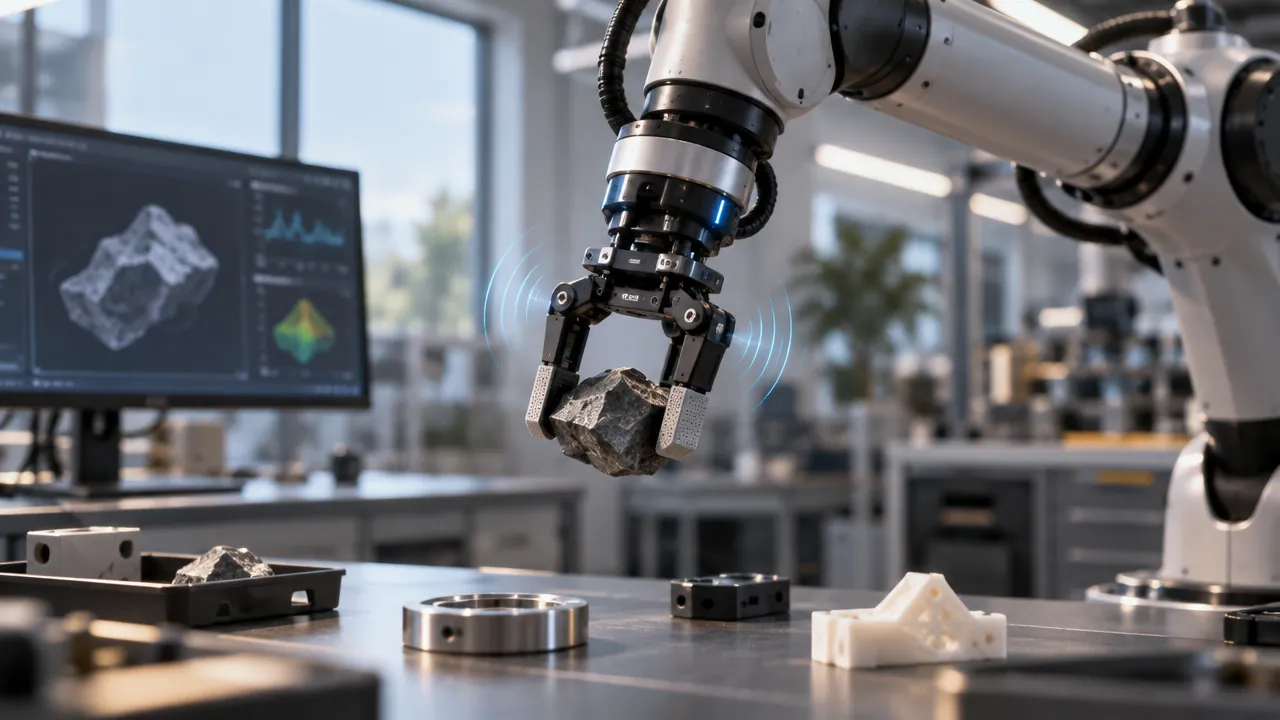
Eka Robotics raised $150 million in a Series A at a $1.45 billion post-money valuation to develop physical AI for robot manipulation. Its approach combines a force-sensing gripper with a deep-learning model, simulation, and reinforcement learning, but broad real-world reliability remains to be demonstrated.
Key takeaways
- Eka Robotics raised $150 million in a Series A at a reported $1.45 billion post-money valuation.
- The company was founded by MIT professor Pulkit Agrawal and former Google DeepMind researcher Tuomas Haarnoja.
- Eka pairs a force-sensitive robotic gripper with a deep-learning model to help robots respond to contact while handling objects.
- Physics simulation and reinforcement learning are intended to expand robot experience beyond a limited set of human demonstrations.
- The funding and valuation signal investor confidence, but do not prove that Eka’s system works reliably across real-world tasks and environments.
Eka Robotics has raised $150 million in a Series A round at a $1.45 billion post-money valuation, backing its effort to build physical AI for robots. The company’s approach pairs a force-sensitive robotic gripper with a deep-learning model designed to help robots manipulate objects - a task that remains difficult outside controlled settings.
The funding is a confirmed milestone for Eka. The larger promise is still being tested: its technology is intended to help robots learn flexible, contact-aware skills, but the valuation alone does not establish how broadly or reliably those skills work in real-world operations.
What Eka Raised and Who Is Behind the Robotics Startup
The Series A was led by a16z and F-Prime. Eka was founded by Pulkit Agrawal, an MIT professor, and Tuomas Haarnoja, a former Google DeepMind researcher.
The company is building what it describes as a physical AI model for robotics. Rather than treating AI as software that only interprets images or text, physical AI must connect perception and decisions to a machine’s actions in the real world. For Eka, that means developing a system around both the robot’s ability to sense contact and its ability to decide how to move.
The funding and valuation reflect investor backing for that approach. They do not, by themselves, show that the system has reached widespread commercial use or solved general-purpose manipulation.
How Eka Combines a Force-Sensing Gripper With a Manipulation Model
Eka’s system combines a flexible robotic hand equipped with force sensing and a deep-learning manipulation model. The gripper can register physical contact, giving the model information about how an object responds as the robot handles it. That feedback can help a robot adjust its grip rather than relying only on visual estimates.
Force sensitivity matters because many everyday objects are easy to damage or awkward to grasp. A robot may need to hold a soft item without crushing it, maintain its grip as an object shifts, or respond when it meets unexpected resistance. A rigid, pre-programmed movement can fail when the object or contact differs from what the robot expected.
Eka’s approach also uses physics simulation to model forces and generate experience for reinforcement learning. In principle, simulated environments can expose a model to many interactions that would be costly or slow to reproduce with physical robots. The model can learn from outcomes and refine its actions, rather than depending entirely on human demonstrations.
That distinction is important. Demonstrations provide examples of how people perform a task, but they may not cover every object, angle, or contact condition. Reinforcement learning can give a robot a way to improve through repeated attempts and feedback. Whether skills learned in simulation transfer consistently to physical settings remains a key challenge for robotics research.
Why Robot Manipulation Is Difficult - and What Eka Aims to Change
Picking up an object is not a single, uniform action. A robot has to identify what it is handling, choose a grip, coordinate its fingers, judge the force being applied, and adapt if the object slips or behaves unexpectedly. Small differences in shape, weight, texture, or position can change what movement will work.
This complexity is one reason robots can perform well in structured, repetitive tasks but struggle with varied objects and changing conditions. Eka is aiming to address the gap by connecting a manipulation model to a hand that can sense force, then using simulation and reinforcement learning to build experience beyond a narrow set of demonstrations.
The company’s funding round marks a substantial bet on that combination of hardware and AI. The central test will be whether it can translate promising learning methods into dependable manipulation across real tasks, objects, and environments.
Explore our coverage of physical AI, reinforcement learning for robots, and the companies investing in more capable machines.
By the numbers
$150 million Series A funding round
The article reports that Eka Robotics raised $150 million in a Series A led by a16z and F-Prime.
$1.45 billion post-money valuation
The article reports this valuation for Eka following its Series A; it is a financing milestone, not evidence of broad commercial deployment or proven reliability.
Step by step
- 01
Sense contact with the gripper
Use the force-sensitive gripper to register how an object responds during handling, adding contact information to the robot’s observations.
- 02
Choose and adjust a manipulation action
Combine perception and contact feedback so the model can select a movement and adjust its grip when an object shifts or resists.
- 03
Generate interaction experience in simulation
Model forces in simulated environments to expose the learning system to varied object interactions that may be costly to reproduce physically.
- 04
Refine behavior through reinforcement learning
Use the outcomes of attempted actions as feedback so the model can improve its manipulation behavior beyond a fixed set of demonstrations.
- 05
Test transfer on physical robots
Evaluate whether simulated and learned skills work consistently with real objects, contact conditions, and operating environments.
Frequently asked questions
What is Eka’s physical AI model?
Eka’s physical AI model is a system designed to help robots manipulate objects using contact-aware feedback. It combines a force-sensitive robotic gripper with a deep-learning model. The company also uses physics simulation and reinforcement learning to build manipulation experience.
How much did Eka Robotics raise?
Eka Robotics raised $150 million in a Series A round. The round was led by a16z and F-Prime, according to the article. It valued the company at $1.45 billion post-money.
Why does force sensing matter for robot manipulation?
Force sensing helps a robot detect how an object responds as it handles it. That feedback can help the robot adjust its grip when an object slips, shifts, or might be damaged by excess force. It can complement vision, which may not reveal all contact conditions.
Does Eka’s valuation prove its robot technology works reliably?
No, a company’s valuation does not prove that its technology works reliably in real-world operations. The funding and valuation show investor backing for Eka’s approach. The key test remains whether its learned skills transfer consistently across real tasks, objects, and environments.
Who founded Eka Robotics?
Eka Robotics was founded by Pulkit Agrawal and Tuomas Haarnoja. Agrawal is an MIT professor, and Haarnoja is a former Google DeepMind researcher. The company is developing physical AI for robotic manipulation.