
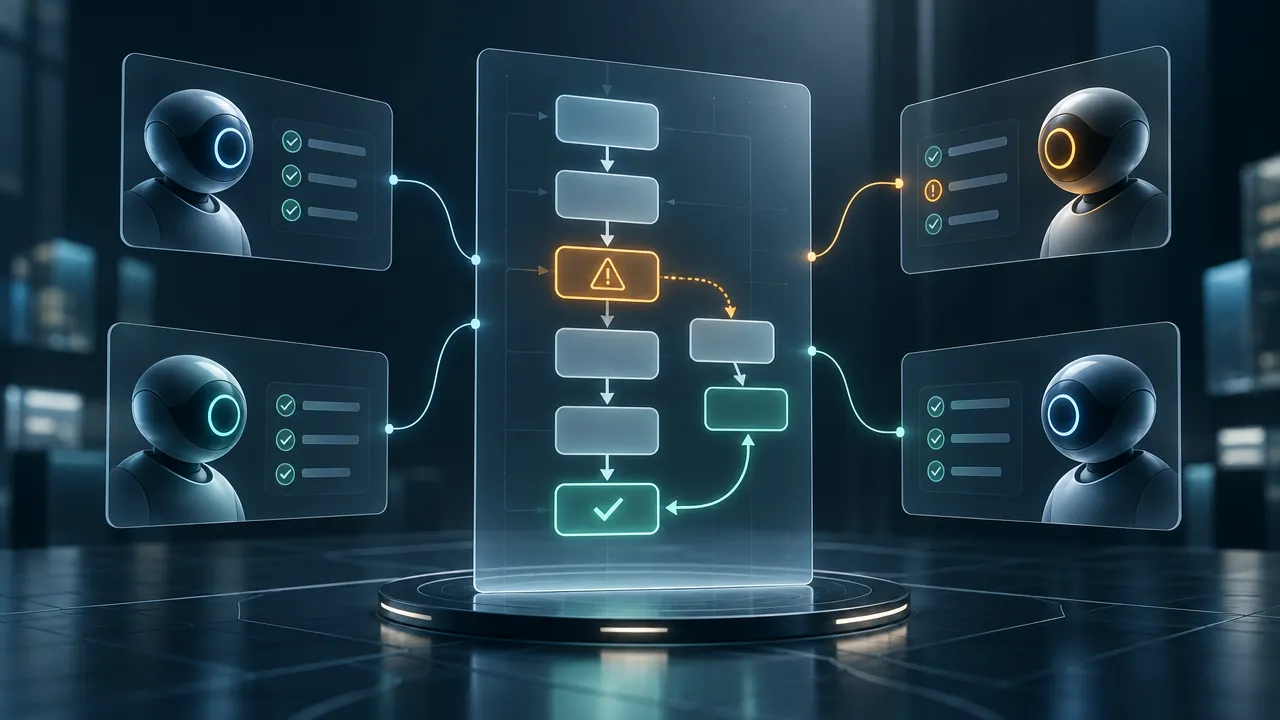
Self-Organizing Agent Teams (SAT) is an AI reasoning audit framework that helps a fixed group of models learn how to assign roles, inspect one another’s reasoning, and repair mistakes. In reported tests across five mathematics and physics benchmarks, SAT outperformed the strongest individual model and a perfect router selecting among independent answers.
Key takeaways
- SAT teaches a fixed roster of AI models reusable strategies for dividing tasks, assigning roles, and checking reasoning.
- The framework focuses on learning how agents collaborate, rather than only generating more answers or following a fixed debate format.
- Across five mathematics and physics benchmarks, SAT outperformed the strongest individual model.
- SAT also beat a perfect router that selected among the agents’ independent answers.
- The reported results are limited to the evaluated benchmarks and do not establish broad reliability on open-ended or high-stakes tasks.
Researchers from Stanford University, Together AI, and Emory University have developed Self-Organizing Agent Teams (SAT), an AI reasoning audit framework that teaches models how to work together. Instead of simply collecting independent answers or asking agents to debate, SAT helps a fixed group of models learn reusable ways to divide tasks, assign roles, inspect one another’s reasoning, and correct mistakes.
The reported results suggest that how AI agents collaborate can matter as much as which models are in the group. Across five mathematics and physics benchmarks, SAT outperformed the strongest individual model and a “perfect router” selecting among agents’ independent answers. The findings point to a potential benefit from structured teamwork, though they do not establish that the approach makes AI systems broadly reliable.
How Self-Organizing Agent Teams structures model collaboration
Many multi-agent AI systems generate several candidate answers and then combine them. Other approaches use multiple rounds of debate or revision, or select the answer supported by a majority. These methods can help, but they do not necessarily give agents a learned process for deciding who should do what or how to check each other’s work.
SAT takes a different approach. Its fixed roster of models reviews the outcomes of previous collaborations and learns strategies that can be reused on later tasks. Those strategies can include assigning specialized roles, organizing the conversation, and auditing another agent’s reasoning for errors that need repair.
The emphasis is on organizing the work, not just increasing the number of answers. A model might handle one part of a problem while another checks the logic or examines a proposed solution. The team’s learned approach can then guide how the agents interact on a new task.
This makes SAT a form of multi-agent AI collaboration in which the agents’ process is itself shaped by experience. Rather than relying only on a fixed debate format or a vote, the system can develop patterns for coordinating its models and scrutinizing their contributions.
What SAT’s benchmark results show
In the reported evaluation, SAT exceeded the strongest individual model across five mathematics and physics benchmarks. It also surpassed a perfect router over agents’ independent answers - a comparison designed to represent selecting the best available standalone response from the participating agents.
That result matters because it suggests coordination can contribute something beyond simply having multiple models produce answers. If a team can identify a weak step, ask an agent to examine it, and repair the reasoning, its final performance may improve without depending on a stronger individual model alone.
The benchmark results are evidence for the approach on the tasks tested, not proof that every agent team will benefit from the same strategy. Performance on math and physics evaluations does not by itself show how SAT would handle open-ended work, changing information, or high-stakes decisions. Nor does outperforming a strong model mean that the resulting answers are always correct.
What the findings mean - and what remains unclear
SAT adds to research into AI agent orchestration by treating collaboration as something models can learn, rather than a conversation pattern that must be specified in advance. The reported gains make structured role assignment and cross-checking worth watching as researchers test more ways to coordinate AI systems.
Important details remain unclear in the available reporting, including a definitive announcement date and further implementation information. More evaluations will be needed to determine whether the results hold across additional models, benchmarks, and real-world problems - and whether the learned strategies remain effective when tasks become less predictable.
For now, the central takeaway is focused: on the reported benchmarks, a team that learns how to work together performed better than individual answers and the strongest single model. Follow future evaluations to see whether SAT’s gains hold across more models and real-world problems, and explore how multi-agent AI systems coordinate tasks.
By the numbers
SAT was evaluated across five mathematics and physics benchmarks.
The article reports this scope for the researchers’ evaluation of Self-Organizing Agent Teams; it does not name the individual benchmarks.
SAT outperformed the strongest individual model across the five reported benchmarks.
This is the article’s summary of the benchmark comparison and should be understood as applying to the evaluated tasks, not all AI use cases.
SAT also surpassed a perfect router selecting among agents’ independent answers.
The article describes this as a comparison against selecting the best available standalone response from participating agents.
Step by step
- 01
Set a fixed team of models
Choose the roster of models that will collaborate, since SAT learns reusable ways for a fixed group to work together.
- 02
Review collaboration outcomes
Use the outcomes of previous team interactions to identify which coordination strategies help the group solve tasks.
- 03
Assign roles and organize the work
Apply learned strategies to divide a task, designate contributors, and structure how the agents exchange their work.
- 04
Audit and repair the reasoning
Have agents inspect proposed reasoning for errors, then use the team’s coordination strategy to revise the solution.
Frequently asked questions
What is the Self-Organizing Agent Teams framework?
Self-Organizing Agent Teams (SAT) is a framework that helps a fixed group of AI models learn how to collaborate on tasks. It uses outcomes from prior collaborations to develop reusable strategies for assigning roles and organizing interaction. The agents can also inspect one another’s reasoning and correct mistakes.
How does SAT help AI models audit one another’s reasoning?
SAT helps models coordinate roles and review one another’s reasoning so the team can identify and repair errors. Its approach emphasizes learned collaboration strategies rather than relying only on independent answers, voting, or a fixed debate format. The article does not specify all implementation details.
What were SAT’s benchmark results?
SAT outperformed the strongest individual model and a perfect router across five reported mathematics and physics benchmarks. The perfect router comparison selected among agents’ independent answers. These results apply to the reported evaluations and do not prove that SAT will perform better on every kind of task.
Does SAT make AI systems more reliable?
The reported benchmarks do not establish that SAT makes AI systems broadly reliable. They provide evidence that learned coordination improved performance on the tested mathematics and physics tasks. Further evaluation is needed across more models, benchmarks, and real-world problems.