
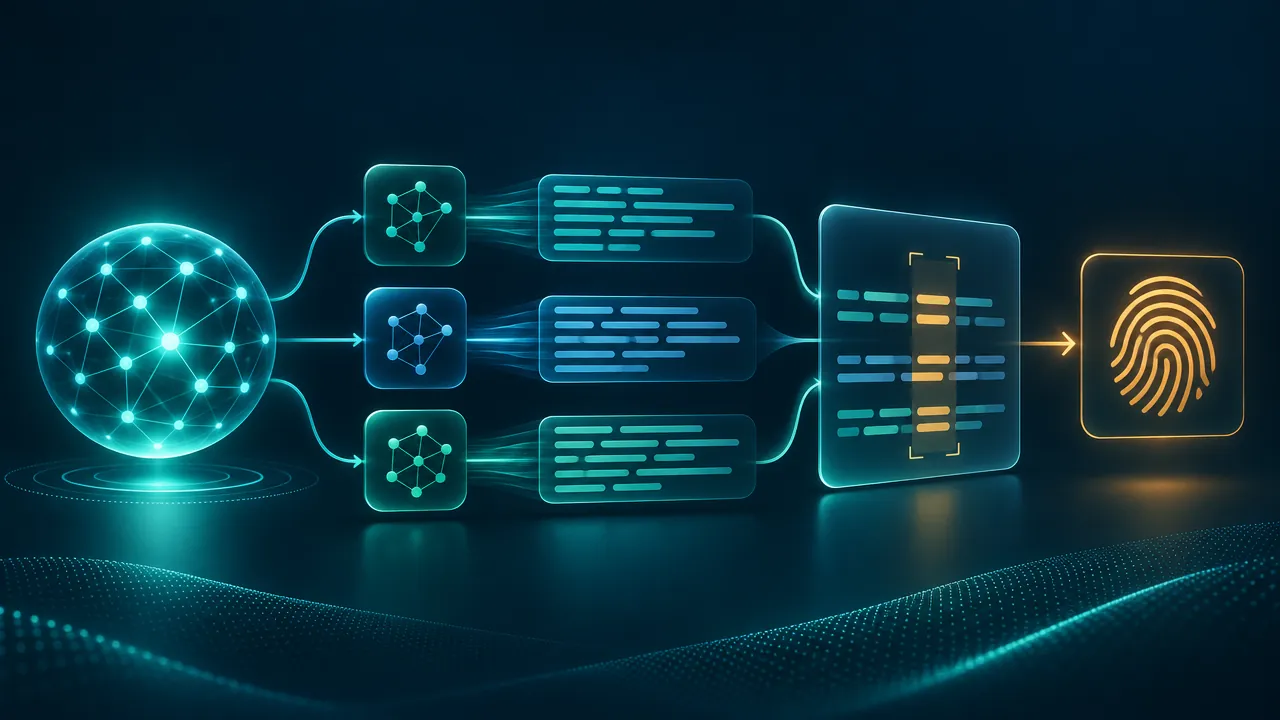
Anthropic is developing FlashProve, a proposed system that could use model-specific fingerprints and cryptographic verification to check whether an AI output is associated with the model it claims to come from. The system is not confirmed as complete or deployed, and verification would not prove that an output is accurate, safe, or unbiased.
Key takeaways
- FlashProve is a proposed Anthropic system for checking the claimed identity of an AI model behind an output.
- The reported approach uses model-specific fingerprints and cryptographic verification.
- The proposal aims to verify identity without exposing a model's underlying weights.
- Local-device verification is a stated design goal, not a demonstrated capability.
- TechCrunch reported the system was under development on November 3, 2026; its performance and adoption remain unconfirmed.
Anthropic is working on a proposed system called FlashProve that could help establish whether an AI output came from the model it claims to represent. The approach would use model-specific fingerprints and cryptographic verification, potentially offering a way to check model identity without revealing the model’s underlying weights.
TechCrunch reported on November 3, 2026, that the system is under development. The report describes its intended design, but does not establish that FlashProve is complete or in use.
Why AI model identity verification matters
An AI service’s name alone does not prove which model produced a response. Outputs can be copied, relayed, or presented as though they came from a different system. That creates a practical provenance problem: users and organizations may need to know whether an answer came from the model they selected, rather than a substitute.
AI model identity verification could help address that gap. If a response can be tied cryptographically to a particular model, a recipient could have stronger evidence of its origin than a label or claim supplied by the service. That would not, by itself, establish that the answer is accurate, safe, or unbiased. It would address a narrower question: which model is associated with the output?
How FlashProve could match outputs to a model
According to TechCrunch’s account, the proposal would have AI labs publish a fingerprint for each model. An output could then be checked against the relevant fingerprint, with cryptographic verification used to test whether the claimed model identity matches.
The analogy is an email signature. A signature can help a recipient check that a message is associated with its claimed sender and has not been altered in a way the signature detects. FlashProve’s proposed fingerprint would play a related role for model identity: it would provide a verifiable reference for checking an output’s claimed origin.
The report says the design is intended to be lightweight, with verification potentially possible on a local device. That could make checking an identity claim less dependent on trusting the platform that served the response. The proposal also aims to make it difficult to disguise one model as another. These are stated design goals, however, not demonstrated performance results in the available reporting.
What the fingerprint reveals - and what remains unconfirmed
The fingerprint is intended to identify a model without exposing its weights. That distinction could matter to developers of closed models: they might be able to offer a way to verify model identity without publishing the model itself or disclosing its underlying parameters.
A fingerprint should not be confused with access to the model or a full account of how it works. Nor does the reported description spell out every technical step, such as exactly how outputs would be matched to fingerprints or what evidence a verifier would see. Those details will matter in judging how well the approach works in practice, including whether it remains useful when outputs are transformed or passed between services.
For now, FlashProve is a proposal under development, not a confirmed deployed verification system. Its value will depend on the eventual implementation and whether model developers and services adopt it. Follow developments in AI model provenance and verification as Anthropic’s proposal evolves.
By the numbers
TechCrunch reported on November 3, 2026, that FlashProve was under development.
This is a report about the proposal's status, not evidence that the system is complete or in use.
The reported design combines model-specific fingerprints with cryptographic verification.
This describes the proposed method; the available reporting does not provide benchmark results or measured accuracy.
Local-device verification and identity checks without exposing model weights are stated design goals.
These are intended capabilities described in the report, not demonstrated performance results.
Step by step
- 01
Publish a model-specific fingerprint
Under the reported proposal, an AI lab would publish a fingerprint associated with a model so it can serve as a reference for checking identity.
- 02
Associate the output with a model claim
Identify the model that the service says produced the response and obtain the information needed to check that claim against its fingerprint.
- 03
Check the identity cryptographically
Use the proposed verification method to test whether the output's claimed model identity matches the relevant fingerprint; the available reporting does not specify every technical step.
- 04
Interpret the result narrowly
Treat a successful check as evidence about the output's claimed model origin, not as proof that the response is accurate, safe, or unbiased.
Frequently asked questions
What is Anthropic's FlashProve?
FlashProve is a proposed Anthropic system for verifying the claimed identity of an AI model associated with an output. TechCrunch reported that it is under development, not confirmed as complete or deployed. The reported design uses model-specific fingerprints and cryptographic verification.
How could FlashProve verify an AI model's identity?
FlashProve could compare a model-specific fingerprint with an output's claimed model identity using cryptographic verification. The report describes the intended approach but does not provide all implementation details. Local-device checking is presented as a design goal, not a proven capability.
Does AI model identity verification prove that an answer is correct?
No, verifying model identity would not prove that an AI answer is correct. It would address which model is associated with an output, rather than the answer's accuracy, safety, or bias. Those qualities require separate evaluation.
Will FlashProve reveal a model's weights?
The proposal is intended to verify model identity without revealing the model's underlying weights. That could help developers of closed models offer identity checks while keeping parameters private. The reported description does not establish how the final implementation will work.
Is FlashProve available now?
FlashProve was reported as under development, not as a deployed verification system. TechCrunch reported on the proposal on November 3, 2026. Its eventual performance and adoption by model developers and services remain unknown.