
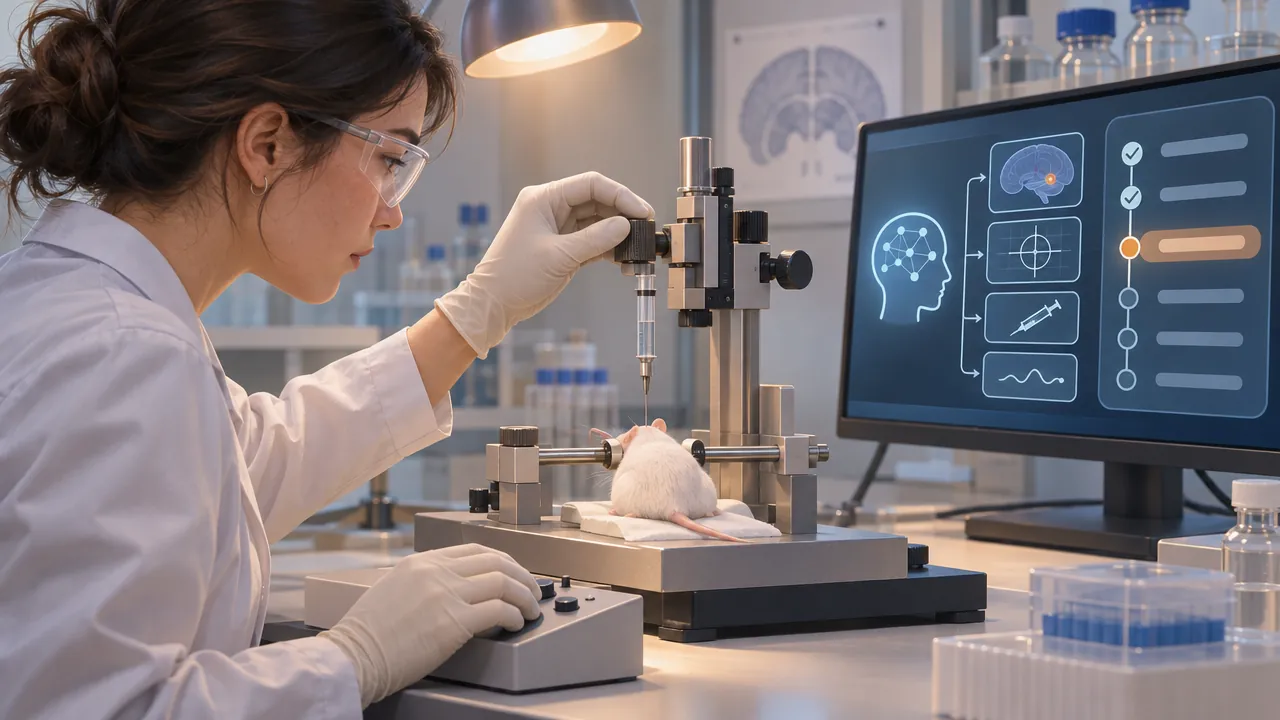
The reported demonstration used an AI agent to carry out a defined drug injection into a live mouse’s brain as part of a researcher-led laboratory setup. It shows AI participating in a bounded physical research task, not independently planning or performing complete brain surgery.
Key takeaways
- The reported task was a drug injection into a live mouse’s brain.
- Researchers defined the experiment and prepared the animal and equipment; the agent carried out an assigned procedure.
- The account does not establish that the AI chose the drug, selected the injection site, or designed the study.
- Performing an injection does not by itself prove a biological effect or a successful scientific result.
- Animal welfare, protocol responsibility, and oversight remain with researchers and their institution.
A research demonstration reported by WIRED put an AI agent in charge of a tightly defined laboratory task: delivering a drug into the brain of a live mouse. The headline-grabbing phrase “brain surgery” describes that invasive injection, not an AI independently planning and performing a complete operation.
The demonstration matters because it shows an AI agent interacting with laboratory equipment during an experiment involving a living animal. It is a concrete example of AI entering the physical workflow of neuroscience research - but a narrow one. The report supports a claim about a specific injection, not about an AI system that can independently conduct brain surgery or make clinical decisions.
What the AI Agent Did - and What Researchers Did
The reported task was an injection into the mouse’s brain. In this kind of procedure, researchers target a particular location and deliver a controlled amount of material through a fine needle. That is materially different from an agent deciding which operation a patient or animal needs, planning all steps, or handling every aspect of surgery without human involvement.
According to WIRED, the AI agent operated as part of a researcher-led setup. The people involved defined the experiment and prepared the equipment and animal; the agent’s role was to carry out the assigned procedure using the laboratory system. That distinction is important: controlling equipment to execute a specified task is not the same as independently choosing the target, drug, or scientific question.
The demonstration’s reported outcome is that the agent injected a drug into a live mouse’s brain. The available account does not establish that the agent chose the drug or determined the injection site on its own. Nor does the injection alone show that the treatment produced a particular biological effect. Those are separate claims that would require evidence from the experiment and its results.
Why the Experiment Was Conducted and What Details Matter
The research is relevant to neuroscience because brain experiments often depend on precise, repeatable procedures. Automating part of that work could help researchers carry out steps consistently and could eventually make some laboratory workflows easier to scale. The immediate achievement, however, is procedural: an AI agent was used to perform a specific drug injection, rather than simply answer questions or analyze data on a screen.
The distinction between a successful action and a successful scientific result also matters. Delivering a drug is one step in an experiment; researchers still need to assess what happened afterward and whether the procedure was reliable. The demonstration does not, by itself, show that an AI agent can design a study, interpret its findings, or replace the expertise needed to work with animals.
Because the procedure involved a live mouse, animal welfare and human oversight remain central. The report describes a research demonstration, not a general authorization for AI systems to conduct animal experiments independently. Responsibility for the protocol, the animal’s care, and decisions about whether the experiment is justified remains with the researchers and their institution.
What This Shows About AI in the Lab, and What It Does Not
This AI agent brain surgery demonstration offers a specific sign of how AI may move from digital assistance to controlling physical laboratory tools. It shows that an agent can participate in a carefully bounded neuroscience procedure under a human-designed setup. That is meaningful progress for laboratory automation, but it should not be inflated into a claim of autonomous surgery.
The next questions are practical: how reliably can the system repeat the task, how are mistakes detected, and what level of supervision is needed? Those answers will determine whether this kind of AI-controlled brain injection can become a useful research tool beyond a demonstration.
For the researchers’ account of the experiment and its setup, read the original WIRED report.
By the numbers
One reported procedure: a drug injection into a live mouse’s brain.
The supplied article summarizes the demonstration reported by WIRED; it describes a specific task rather than a broad autonomous-surgery capability.
No quantitative accuracy, repeatability, or biological-outcome metrics are provided in the supplied article.
The article distinguishes the reported injection from claims about reliable performance or experimental effects, which would require further evidence.
Frequently asked questions
What did the AI agent do in the live-mouse demonstration?
The AI agent carried out a drug injection into a live mouse’s brain as part of a researcher-led setup. The procedure was a defined laboratory task involving equipment and an animal. The report does not establish that the agent independently planned the experiment or chose the drug.
Did the AI independently perform brain surgery?
No, the demonstration does not show an AI independently planning and performing complete brain surgery. The phrase “brain surgery” refers to the invasive injection described in the report. Researchers defined the experiment and prepared the setup.
What does the AI brain injection demonstration prove?
It shows that an AI agent participated in a specific physical neuroscience research procedure. It does not, by itself, prove that the injection was repeatable, produced a particular biological effect, or could be performed safely without supervision. Those claims require additional evidence.
Who is responsible for animal welfare during AI-assisted experiments?
Researchers and their institution remain responsible for animal welfare and oversight. The demonstration is a research report, not general authorization for AI systems to conduct animal experiments independently. The research team remains accountable for the protocol, animal care, and whether the experiment is justified.