
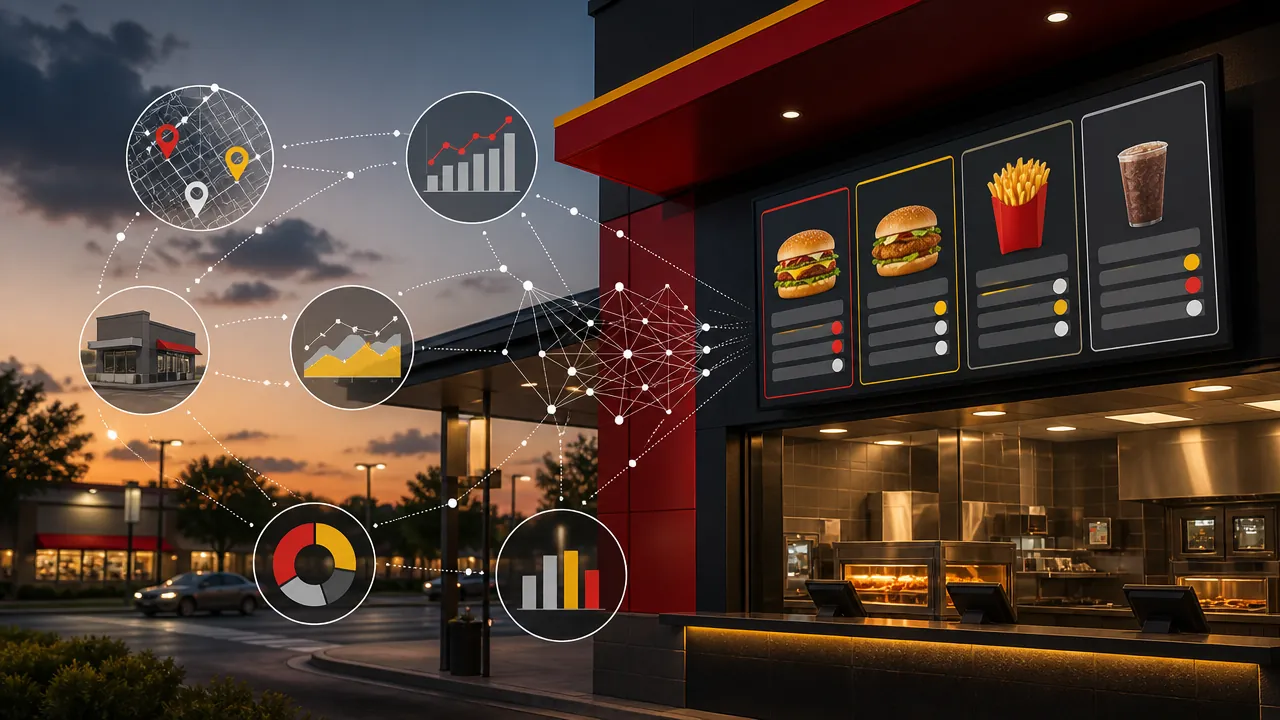
McDonald’s reportedly uses machine learning to recommend item-level menu prices for individual restaurant locations based on transaction, pricing and local market data. The system is described as decision support rather than individualized real-time pricing, with franchisees and managers still involved in reviewing and applying recommendations.
Key takeaways
- McDonald’s AI pricing system reportedly recommends prices by restaurant location and menu item, rather than assigning a unique price to each customer.
- The system analyzes large volumes of transaction and pricing data to estimate how demand may respond to price changes.
- Local competition, customer demand and estimated willingness to pay may influence recommendations, although the complete list of model inputs is not publicly established.
- The technology is best classified as machine-learning decision support, not generative AI or necessarily automated surge pricing.
- Human review, transparency, bias testing and governance remain essential when algorithmic recommendations affect affordability and customer trust.
McDonald’s is using machine-learning technology to recommend menu prices for individual restaurant locations. The system processes large volumes of transaction and pricing data, then suggests item-level prices that may fit local market conditions.
This is not the same as charging every customer a different price in real time. The reported use case is a restaurant-level decision-support system: artificial intelligence produces recommendations, while people—including franchisees and managers—remain involved in pricing decisions.
What McDonald’s AI Pricing System Actually Does
It recommends prices for individual restaurant locations
A single menu price may not perform equally well everywhere. Restaurants operate in markets with different rents, wages, customer demographics, competitors, and demand patterns. A price that works in one location may be too high—or unnecessarily low—in another.
McDonald’s pricing engine reportedly recommends prices for specific restaurants and individual menu items. For example, it could assess whether a particular location might support a small increase on one product while keeping another price unchanged. The goal is to give decision-makers more precise guidance than a single, network-wide pricing rule.
The important distinction is that the system recommends prices by restaurant location, not necessarily by individual customer. It is designed to help answer questions such as: “What price is likely to work in this market?” rather than “What is this specific person willing to pay today?”
It analyzes transaction and pricing data at scale
The system draws on data from millions of daily transactions, along with historical and current pricing information. Machine-learning models can examine relationships that would be difficult to identify manually across a large franchise network.
A simplified process might look like this:
- Collect data: The system receives transaction, menu, and pricing information.
- Identify patterns: It compares sales performance across products, locations, and time periods.
- Estimate response: The model evaluates how demand may change when an item’s price changes.
- Generate recommendations: It suggests item-level prices for particular restaurants or markets.
- Review and implement: Human decision-makers assess the recommendations before applying them.
This approach turns pricing from a periodic, broad decision into a more data-informed process. It does not eliminate judgment; it gives managers and franchisees another source of evidence.
Which Factors Influence McDonald’s Price Recommendations?
Local competition and market conditions
The pricing engine reportedly considers local competition. Nearby restaurants, their menu prices, promotions, and positioning can influence how customers view value at a particular McDonald’s location.
A restaurant in a market with many low-cost alternatives may need a different pricing strategy from one with fewer direct competitors. The model can help identify those differences rather than assuming every restaurant faces the same conditions.
Other local factors may also appear in the data, such as product demand, ordering patterns, and previous responses to price changes. The available reporting does not establish every variable used by the system, so it is better to describe these as possible inputs rather than a confirmed list.
Estimated customer willingness to pay
Another reported factor is estimated customer willingness to pay. In practical terms, the model attempts to predict how sensitive demand may be to a price change in a particular restaurant’s market.
If customers in one area appear relatively responsive to small price increases, the system may recommend caution. If demand has remained stable after earlier changes, it may identify more room to adjust prices. These are market-level estimates based on observed patterns—not direct knowledge of what each person can or will pay.
Willingness-to-pay modeling is imperfect. Customer behavior can change because of inflation, income pressures, promotions, seasonality, or a competitor’s new offer. That is why recommendations should be treated as estimates, not guarantees.
This Is Machine-Learning Pricing, Not Generative AI
The term “AI” covers several different technologies. McDonald’s reported pricing system is best understood as a machine-learning application, not a generative-AI chatbot that writes menus or creates marketing copy.
Machine-learning pricing models analyze structured business data, find statistical patterns, and produce predictions or recommendations. Generative AI, by contrast, creates new text, images, audio, or other content in response to prompts.
The distinction matters because the pricing system’s value comes from forecasting demand and comparing outcomes at scale. Its central task is analytical: use past and current data to support a business decision.
Do Franchisees and Managers Still Set the Prices?
Available reporting describes AI as generating recommendations, but it does not establish that the system automatically sets every restaurant’s prices without human involvement.
That leaves an important role for franchisees, managers, and other decision-makers. They may consider whether a recommendation fits local customer expectations, operational costs, brand strategy, and competitive conditions. They can also account for information the model may not yet reflect, such as a nearby restaurant opening or a local event affecting demand.
Human review does not automatically make an algorithmic recommendation fair or correct. People still need to understand what the model is measuring, how often it is updated, and when its recommendations should be rejected. But human involvement distinguishes decision support from fully automated pricing.
What McDonald’s AI Pricing Does—and Does Not—Mean for Customers
Restaurant-level recommendations are different from personalized prices
The reported system focuses on recommendations for restaurant locations. There is no indication in the available reporting that McDonald’s uses each customer’s personal data to create a unique menu price for that individual.
That distinction separates restaurant-level pricing from personalized pricing. A location might display the same recommended price to everyone ordering there, even if the recommendation was informed by aggregated transaction patterns from that market.
Customers may still perceive frequent or localized changes as “dynamic pricing,” especially if prices differ between nearby locations or ordering channels. Clear communication can help explain whether a change reflects a local menu decision, a promotion, or a genuinely individualized offer.
Why transparency and fairness still matter
Even when prices are not personalized, algorithmic pricing raises legitimate questions. Customers may want to know why prices vary by location, what data informs recommendations, and whether certain communities face systematically higher prices.
Businesses using these systems should test models for unintended bias, monitor outcomes, protect customer information, and maintain clear approval rules. They should also avoid presenting model outputs as objective facts. A recommendation reflects the data and assumptions built into the system.
Why AI-Assisted Menu Pricing Matters for Restaurants
The potential benefits of more localized pricing
Restaurant-level recommendations can help operators respond to real differences between markets. Potential benefits include:
- Better demand forecasting: Models can identify how sales may respond to price changes.
- More relevant local decisions: Restaurants can account for nearby competition and market conditions.
- Faster analysis: Large datasets can be assessed more quickly than through manual review.
- More consistent decision support: Franchisees can receive a common analytical framework while retaining local judgment.
Used carefully, this can make pricing more responsive without requiring a business to treat every customer differently.
The risks of opaque or overly dynamic pricing
The same technology can create problems if recommendations are poorly explained or applied too aggressively. Frequent changes may weaken customer trust. Models trained on historical data may reproduce past inequalities. And a system optimized mainly for revenue could overlook affordability, brand perception, or long-term loyalty.
The broader lesson is straightforward: AI can improve pricing analysis, but governance determines how that analysis affects people. McDonald’s use case illustrates a conventional enterprise-AI pattern—large-scale data processing, machine-learning recommendations, and human implementation—not necessarily individualized surge pricing.
Follow the latest developments in AI-powered business decision-making to see how companies are applying machine learning in the real world.
By the numbers
The reported system processes data from millions of daily transactions.
This figure comes from the article’s source material describing the scale of McDonald’s transaction data; it should be treated as a reported operational scale rather than an independently verified model benchmark.
The reported recommendation scope is restaurant-level and item-level, not necessarily customer-level.
The article distinguishes recommendations for individual restaurant locations and menu items from unique prices generated for individual customers.
The system is described as using machine-learning analysis rather than generative AI.
This classification follows the article’s technical distinction: the system analyzes structured business data to forecast demand and recommend prices instead of generating text, images or other creative content.
Step by step
- 01
Collect transaction and pricing data
Aggregate historical sales, menu prices, item performance and relevant restaurant-level information while applying appropriate privacy and data-governance controls.
- 02
Compare local demand patterns
Analyze product performance across restaurants, time periods and market conditions to identify differences in demand and customer price sensitivity.
- 03
Estimate price response
Use machine-learning models to forecast how demand could change when the price of a specific menu item increases, decreases or remains unchanged.
- 04
Generate restaurant-level recommendations
Produce suggested prices for individual menu items and locations, distinguishing local decision support from personalized prices for individual customers.
- 05
Review and approve recommendations
Ask franchisees, managers or other authorized decision-makers to assess model outputs against competition, operating conditions, brand strategy and local knowledge.
- 06
Monitor outcomes and fairness
Track sales, customer response, price changes and potential disparities, then update or reject recommendations when the model produces unreliable or harmful results.
Frequently asked questions
Does McDonald’s use AI to charge every customer a different price?
No, the reported system recommends prices for restaurant locations rather than assigning a unique real-time price to every customer. A local menu price may be informed by aggregated transaction patterns, but the available reporting does not establish individualized pricing for each person. Customers may still see differences between locations or ordering channels.
How does McDonald’s AI recommend menu prices?
McDonald’s reported pricing system analyzes transaction, pricing and market data to estimate suitable item-level prices for specific restaurants. Machine-learning models look for patterns in demand and price response across products, locations and time periods. The resulting recommendations are intended to support human pricing decisions rather than replace them entirely.
What factors can influence McDonald’s AI pricing recommendations?
Potential factors include local competition, historical demand, previous price responses, ordering patterns and estimated willingness to pay. The source material does not confirm every variable used by the system, so these should be treated as reported or possible inputs rather than a definitive model specification. Inflation, promotions, seasonality and new competitors can also affect how reliable a recommendation is.
Is McDonald’s AI pricing the same as dynamic pricing?
No, restaurant-level AI recommendations are not necessarily the same as individualized or real-time dynamic pricing. The described system supports prices for locations and menu items, while dynamic pricing can imply frequent changes tied to current demand and personalized pricing can vary by customer. Customers may nevertheless perceive localized or changing prices as dynamic pricing if the process is not clearly explained.
Do franchisees and managers still set McDonald’s menu prices?
Available reporting indicates that franchisees, managers and other decision-makers remain involved in reviewing and applying pricing recommendations. Human reviewers can consider local events, operating costs, customer expectations and competitive changes that may not be fully represented in the model. Their involvement makes the system decision support rather than confirmed fully automated price setting.